June 26, 2026
How to make objectively good choices
Choosing almost always inspires anxiety. This is the case because, whatever it is we're choosing, we're always trying to make "the right choice." But this is the wrong approach angle.

Choosing almost always inspires anxiety. This is the case because, whatever it is we're choosing, we're always trying to make "the right choice." And it's no wonder, since we often equate the right choice as being synonymous with either "the best outcome" or "our desired outcome." All of our most important decision, then, always start out with an impossible task: control the future.
Epictetus says in Discourses that there are things which are up to us and things which are not. He says the only things that are up to us are some of our emotions, some of our thoughts, and, ultimately, all of our choices and opinions. Things which are not up to us are everything else. Things like reputation, wealth, whether others like us, the future... these things are not up to us.
So where we in contemporary times start most decision making processes by attempting to predict and control the future, a Stoic begins their decision making process by asking a simple question: what choice aligns with my roles and duties?
First: how is this all "objective"
Think of mathematics. Mathematics is a framework that we've developed to describe a phenomena in the world. So mathematics is a human creation, not a feature of the Cosmos (like the forces of gravity or electromagnetism). This might lead someone to say something like, "Mathematics is subjective!" But this would either be disingenuous or ignorant. Mathematics is a shared language that describes objectively real phenomena, so while we "made it up" we did not make up what it describes. The same is true of goodness. If we define goodness as "that which benefits or is alignment with Nature" and badness as "that which is detrimental or out of alignment with Nature" (which is exactly what the Stoics did), and we can agree that benefit and detriment exists as objectively real phenomena in the world, then we can "make up" shared language and frameworks to discuss and analyse it.
This Stoic framework for choosing (which follows) is just like mathematics in that regard.
From orthodox role ethics to workplace ethics
The Ancient Stoics determined the justness or goodness of a decision by connecting it to four categories of roles (human, individual, assigned, and chosen), ensuring that, in no way, did that choice violate the duties of their oikeôtic roles (roles which were appropriate for them to have taken on).
From the orthodox position, all this relates up to the highest order of Stoic Physics, but for our purposes here we need not explore that. Suffice it to say, the orthodox manner of making objectively good choices relied on the framework of role ethics and can be summarily understood using the simplified chart below.
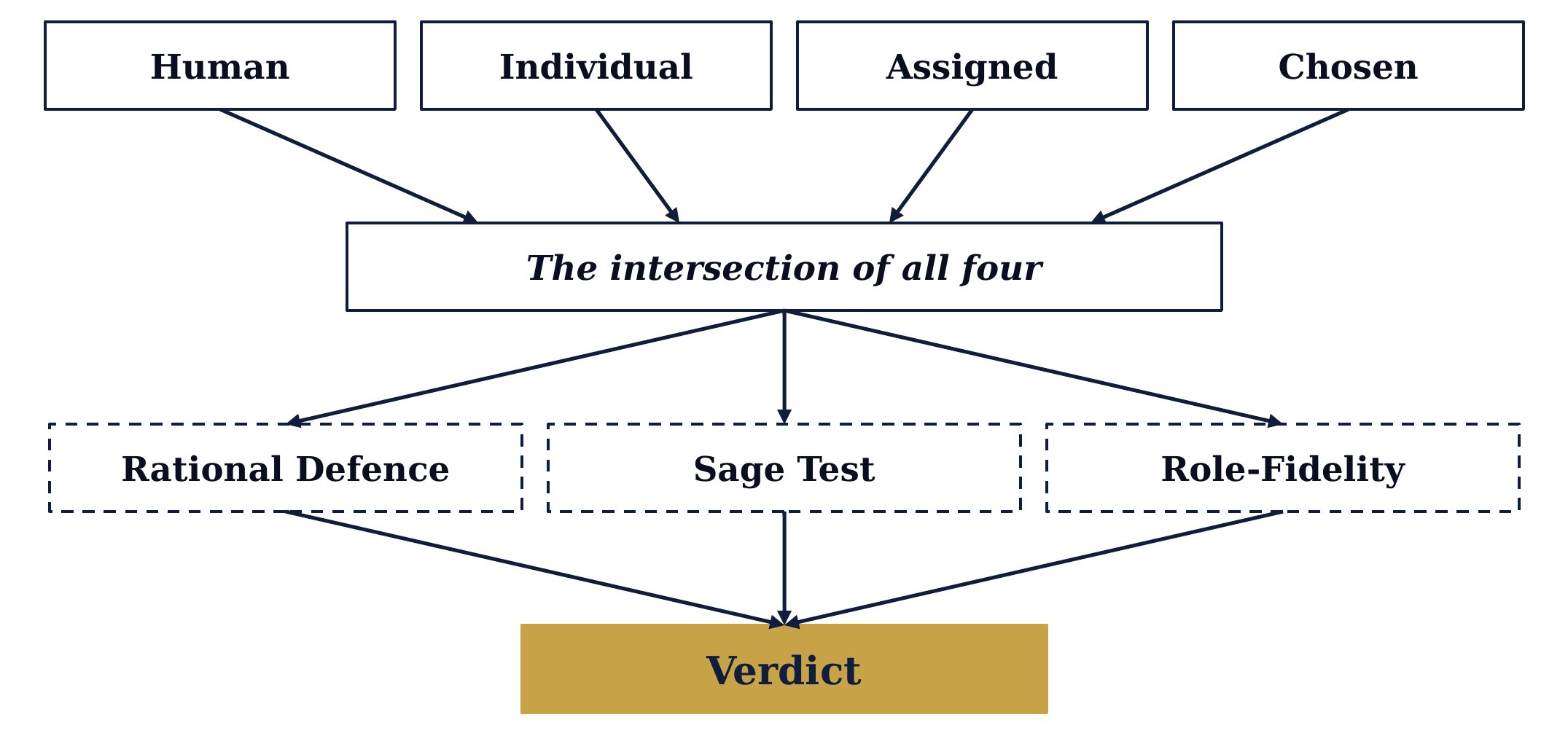
Here's an example of how to apply this in a real-life, somewhat common, situation: your brother asks to borrow £5,000 for a business idea.
So you start with the roles in play: you're his brother (assigned), a human being (human) who owes rational regard to another person, and an individual with your own finances and risk tolerance (individual). Then run the three tests.
Rational Defence: can you justify the loan on reasoning and not guilt?
Sage Test: would a wise, clear-eyed, genuinely generous person lend in this exact situation, or have a harder conversation first?
Role-Fidelity: is this what a good brother does, or what a guilty brother does?
If all three pass, lend it. If any one fails, decline kindly (or propose other choice candidates). Either way, you've made an objectively good choice within this framework for choosing.
Porting this over to the workspace is pretty straightforward
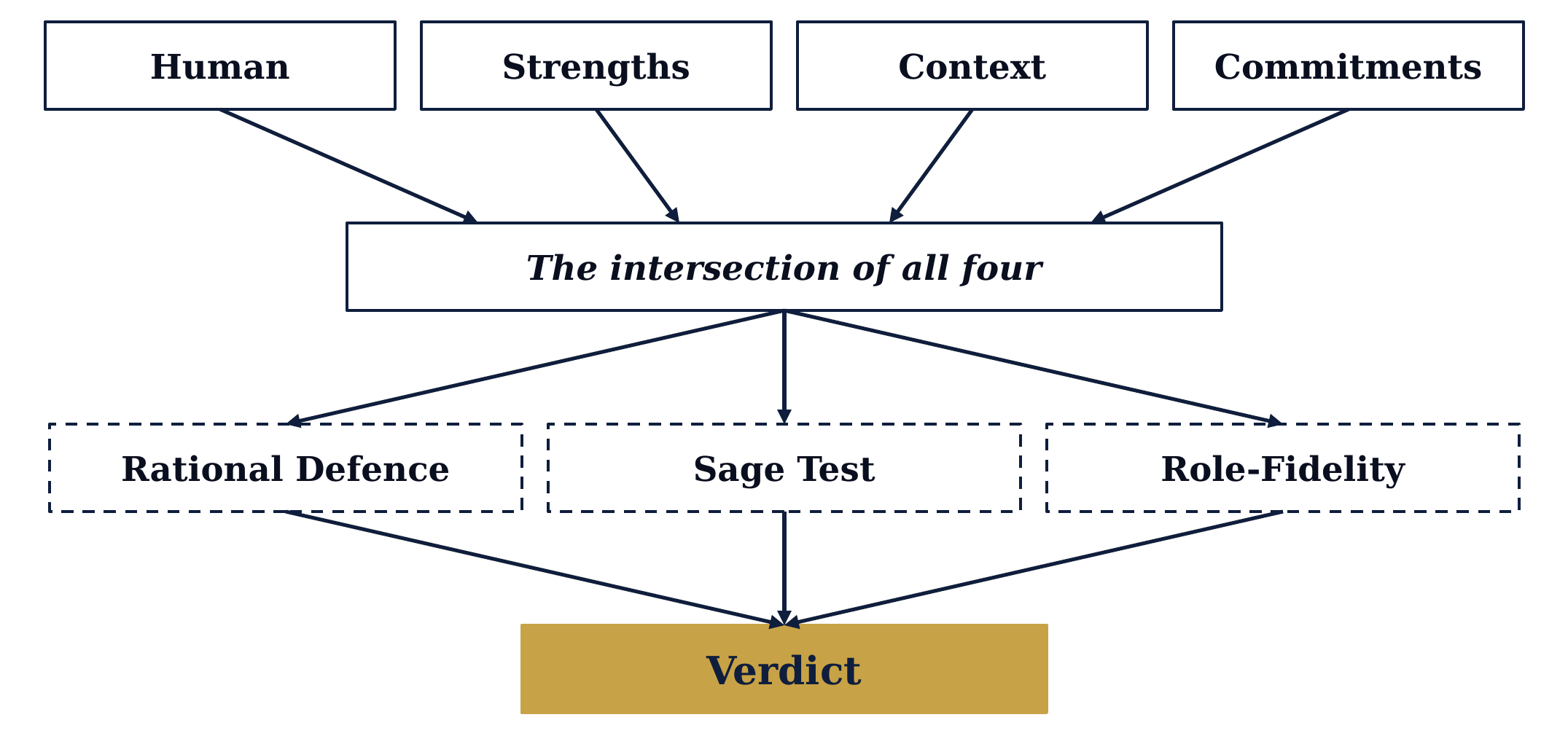
Notice the change: the orthodox Stoic roles have been partially replaced by strengths (also competencies), context, and (previous) commitments.
Let's work through this modified flow with another example: A senior leader (who is also your report, and also your hire) you rely on has been hiding that a major initiative is failing, fudged the numbers in two reports, and is going through something genuinely hard at home. The board wants real figures next week.
The choice candidate on the table is to address it privately, correct it publicly, and keep them on with conditions. Is this choice an objectively good choice if we run it through the framework?
Again, you start with the roles in play.
As human, you owe your colleague a clear-eyed account and the chance to respond, and you owe everyone else the truth (looking the other way protects one person by betraying everyone else involved -- which is clearly in conflict with your roles). Considering your strengths (and weaknesses), you identify your default mode of behaviour before it runs away with you (for example, if you avoid conflict you'll soften into kindness and do wrong by the company; or if you're decisive to a fault you'll fire them on the spot and do wrong by them). Considering the context: the board deadline, the team's ignorance, and the company's tolerance for integrity lapses are constraints you didn't choose but must decide inside of. Considering commitments, you promised this colleague, when you hired them, both development and fairness -- at the same time, you promised the organisation honesty and integrity. In this scenario these promises are right up against one another, but that doesn't mean you get to fulfil one promise at the expense of the other.
Many of the leaders I've worked with in the past are (initially) quick to prioritise their promises to the business (mainly) as an act of self-preservation. But, as I'm equally quick to point out, that's not leadership that's cowardice. Our desire should always be to satisfy our duties to those we benefit and those who benefit us.
Next we run the decision candidate through the three tests.
Rational Defence passes: you can defend every part on reasoning rather than guilt or fear. The numbers go public because they must; the colleague stays on because hiding a failing project under personal strain is a correctable mistake, not a firing offence.
Sage Test passes: someone wise and fair would neither destroy a good person over one mistake nor let doctored numbers stand. They'd do both hard things at once, telling the truth and maintaining compassion.
Role-Fidelity passes: a good manager, a fair colleague, and an honest steward all do this same thing in this scenario. The roles only seemed to conflict. Done this way, they point the same direction.
Verdict: give the board the real figures next week with no softening, tell your report first and face to face before anyone else hears it, and keep them on with clear conditions and support, because the failure wasn't malicious.